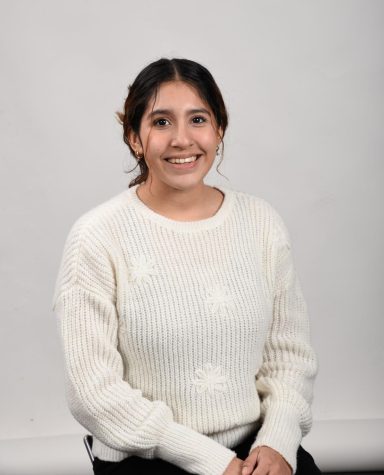
It was 3 a.m. when Noemi Reyes was scrolling on her phone because she couldn’t sleep when she saw an email from the U.S Citizenship and Immigration Services (USCIS). She immediately woke her husband, Omar Perez.
Noemi said Omar couldn’t believe it at first. It was exciting to receive the email, but also scary.
The email included details regarding Omar’s naturalization interview date in Ciudad Juárez, which he had been anticipating for four years.
Omar began the process of applying for the Adjustment of Status, also known as a green card, in 2018. The process allows individuals in the United States to become lawful permanent residents.
“When the other person isn’t a resident, it’s like a pending thing if he will return or not, especially how things are now,” Noemi said.
After Omar and Noemi married, they started a business together, called Mateo’s Concrete, LCC and had two daughters, who attend school. They felt it was time to begin the process; however, it came with a few challenges.
For many immigrants, the process is marked by uncertainty
Omar said he recalls feeling nervous after receiving the interview date.
“I think I felt a little nervous because you really don’t know what they will tell you, so it was a bit stressful because you go with the knowledge that you could return or you might not, so it’s really worrisome, truly,” Omar said.
Receiving the interview date brought mixed emotions and became one of many challenges in Reyes’ case.
When Omar first began the process in 2018, the COVID-19 pandemic hit a year later, causing immigration offices to shut down.

Noemi said it was one of the reasons why the process took so long, but she had also heard stories of it taking a long time, even though there isn’t a pandemic.
On average, obtaining a green card can take from 2 to more than 5 years.
In four years, Omar had two lawyers and paid $12,000.
“The reason the price went up so much was because we had a lawyer, and then she [lawyer] stepped back, and we had another lawyer, who was asking for the same price, $6,000,” Omar said.
He then added that the total cost of the process, including the cost to Ciudad Juárez for his interview, was $15,000.
Their oldest daughter stayed behind to attend class. The youngest traveled to Ciudad Juárez since Omar and Noemi were unsure of their return.
“We took our youngest daughter out of school and signed her up again when we returned,” Noemi said.
Omar, Noemi and their youngest daughter spent thirteen days in Mexico.
Noemi said she recalls it being very stressful because she didn’t know if she would be returning home alone with their daughter.
“I entered Mexico crying because once you cross the border, that’s when reality hits and you start saying, ‘What if they don’t give him anything? What if he can’t return home with me?’” Noemi said.
Omar said he felt like he was back in his country. However, Noemi said Omar gave himself that mentality to stay calm.
“I think in order for him not [to] feel bad, it was his way of trying not [to] worry, more so because he was seeing me cry, and well, we can’t both be crying,” Noemi said.
During their time in Ciudad Juárez, they stayed at Rosita’s Shelter, a place where people can rent a room or a house, and workers then take the interviewee to appointments.
“Even though it’s stressful and scary, it’s the wait to see what happens,” Noemi said.
On the day of the interview, Omar recalls the minutes and the hours in the interview, charged with a lot of adrenaline.
For many applying for the Adjustment of Status, the complications and worries don’t end there
Once an individual obtains a green card, they must wait a couple of years before applying to become a U.S citizen.
According to U.S. Citizenship and Immigration Services, an individual can apply for naturalization with an application fee of $760 for paper filing and $710 for online filing.
In addition to waiting years to be eligible and paying costly fees, they must take a test.
It consists of an English language proficiency test in three categories: speaking, reading, and writing. The civics test covers U.S history, and government facts and laws.
Rosaicela Carreno, a cottage baker who already had her green card, felt she needed the naturalization test to become a U.S. citizen.
Carreno said it was hard for her.
“Because I don’t speak a lot of English and there are 100 questions, 35 written, that you have to learn, and 35 speaking questions, and out of all those questions they only ask you one, and from the 100 questions they ask you six,” Carreno said. “But you have to learn all of them, because you don’t know which one they’ll ask you.”
In 2024, she took the exam and failed.
“I didn’t pass the first exam because I was so nervous,” Carreno said.
After Carreno failed, she studied more to pass the next exam.
Carreno was given another chance to take the exam and she passed.

“Now I can vote, I can fly and leave for months,” Carreno said.
From anxiety to approval: A family reunites
When Omar received the news, he said he recalled the interviewer saying, “Welcome to the United States.”
“At first, you can’t believe it. I think there’s so much emotion that you don’t think about anything, just that you can return to the United States,” Omar said.
While it is not mandatory to accompany your partner, Noemi decided to wait several hours in the intense heat for Omar.
Once she noticed people coming out of the building, she decided to return to a nearby bridge with shade to look for Omar. Once Omar saw her, he waved his green paper to show her.
“She stayed at the bridge, and I showed her the paper [showing] that they had accepted me, and thank god everything turned out well,” Omar said.
Noemi said she is thankful that they only spent thirteen days in Ciudad Juárez because she spoke with people who had been there for months.
She said it went well because they weren’t there for very long, but it was stressful and sad, giving her a lot of anxiety, to the point where she couldn’t sleep. She also added that there are people who struggle much more.
“They want to do things right, one thing after another, and it’s difficult for them because there’s a lot of paperwork,” Noemi said. “And sometimes, well, it can be very expensive.”
Omar said he plans to wait three years before taking the naturalization test to become a U.S citizen.