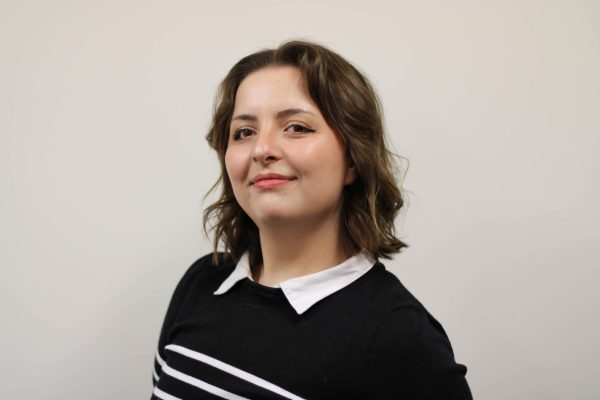

Editor’s Note: The band, Arachnophobia, was interviewed on October 24th, 2025.
Arachnophobia’s story dates back to the ’90s, before any of its members were even born, to a band called JEB.
When Patrick “PJ” Simmons brought three friends to see his father perform with JEB, a single comment from a stranger blossomed into what we now know as Arachnophobia.
“You guys look just like the Beatles,” a woman behind them said.
Later that night, with this comment still rolling around in their heads, one of them said, ‘We should start a band.’
It’s unclear whose mouth these fateful words tumbled out of, but the four teens liked the idea, and with access to musical instruments and equipment via the Simmons family, they had everything they needed.
Thus, a band was born.
It wasn’t until a name and lineup change that the band assumed its final form as Arachnophobia, now a trio. With Simmons shouldering the roles of vocalist and guitarist, fraternal twins Maxwell and Will Rasche became the band’s drummer and bassist.
Contrary to what one might expect, their new name was born from their love for insects and arachnids. The story behind it is familiar to many of us, of loved ones killing harmless bugs for simply occupying the same space as them.
Instead of imitating this behavior, they became upset with it.
When referring to the logo and name of the band, “I made it because people are afraid of what they don’t understand, especially with spiders,” Max Rasche said.
While the band may have started by emulating classic Nirvana, they didn’t stay there. Now, bands like Led Zeppelin, Black Sabbath and, in a full-circle moment, the Beatles, affect their sound.
Simmons’ favorite band is Silverchair, an Australian rock band that was active from the ’90s until the early 2010s. Their lyrics, especially, influence him.
There is no denying that Zach Hill is Max Rasche’s North Star, with him citing Hill’s work in hip-hop band Death Grips and rock band Hella as his inspirations.
“It’s [drumming style] just fast-paced, or weird time signatures and time switches,” Max Rasche said. “I like doing that stuff.”
Will Rasche credits Les Claypool of Primus, an ’80s band that spans various genres like funk and metal, as being a major influence on his bass-playing, in addition to Tool, a ’90s group whose music encompasses a range of rock and metal sub-genres.
“I don’t like supporting bass,” said Will Rasche. “I like to be integrated into the song as if it’s almost more like a melody rather than a bass underlay.”
More impressive than their passion for music is how quickly Arachnophobia has grown. Predominantly self-taught musicians, the three were already performing before cheering crowds after only a few years of practice.
As high schoolers, they had to turn down opportunities because they overlapped with their school schedule.
Then there was the challenge of being taken seriously as musicians.
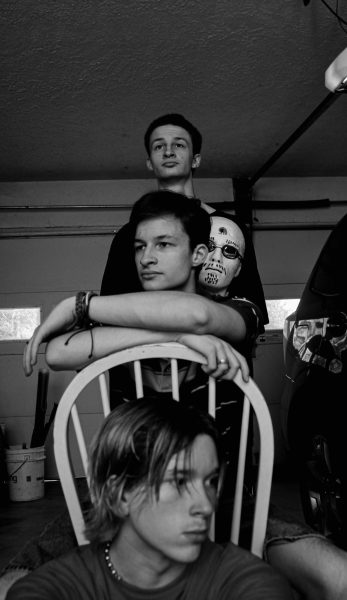
Through social media, they found other young musicians who are succeeding against the odds.
“That’s what made me start realizing that we could take the music more seriously and maybe make something of ourselves,” PJ Simmons said.
Simmons frequently begins his songwriting process with lyrics.
“I started writing lyrics as a form of poetry, and I based the instruments and the music off of the emotions … of the lyrics or words,” Simmons said.
If the emotion was anger, he’d speed up the song, and if it was sadness, he’d slow it down. Then, he’d bring this to the Rasches so they could all write their parts.
“PJ would usually just start playing like. He would just start playing the song in our garage. He would just start singing, and then he would play through it all, and we would look at him, confused, and then he would play it again,” Will Rasche said.
Eventually, their confusion is replaced by music as Max and Will Rasche begin to play, testing out what sounds work well together.
Although Simmons does most of the writing for the band, occasionally the twins, or as Will Rasche calls them, the “rhythm powerhouse” of the band, will bring a song to Simmons. Then Simmons will add lyrics to it. This workflow can be seen more in their first album.
For their second album, Simmons wanted it to be more emotionally driven.
“Last album was punk rock kind of grunge stuff,” Simmons said. “I wanted this to be more like a John Lennon album, where it has artistic integrity, but it is palatable to different people with different emotions collectively into one album.”
Will Rasche credits this shift to a change in their motivations.
“We started the band off as something that was fun and engaging, especially in playing shows. That’s all we wanted to do is play shit,” Will Rasche said.
While they want to continue making music that people can enjoy and have fun with, they also want to express themselves in it.
“Now, we want to focus more on making music as an art form where people can appreciate the meaning of our music,” Will Rasche said.
For their second album, they considered naming it “Iridescence” or “Iridescent” to represent the wide range of emotions in it.
“In that album, we’re going to incorporate aspects from each of our creative styles, in order to show that individual band members make up the overall vibe of a band, and you can’t ever place one person’s value over another in a band, because everyone supports each other,” Will Rasche said.
After seeing how much they’ve accomplished already, I am excited to see what the future has in store for them.
You can keep up with them on Instagram or listen to their work on Spotify and other platforms.