
For many of us, quilts are just another item that lines the racks of thrift stores. They make us ask the usual questions as we sift through coat hangers, ‘Do I need it?’ ‘Do I want it?’ ‘Do I have room for it in my home?’
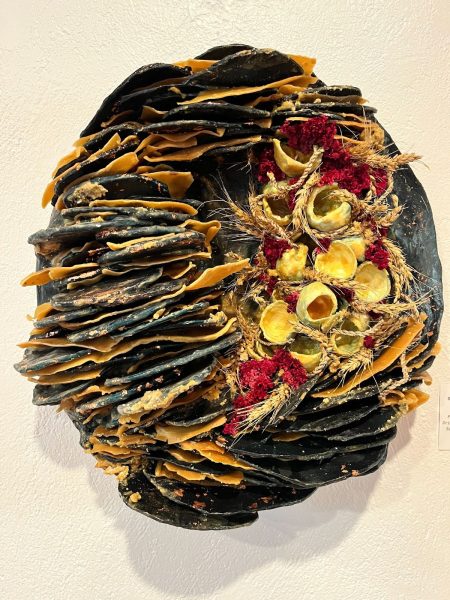
Photo courtesy of Sarah B. Wolfe
Artist Sarah B. Wolfe sees something else entirely.
“If I find a quilt top … I have a hard time not buying it,” Wolfe said. “I think of the time and the care that went into making the object, presumably for a loved one, an object that was meant to care for them, to keep them warm, to comfort them.”
Although Wolfe continues to work on her series “Opusilva: Woodland Works,” with fabric, she has begun to take her artwork in a new direction.
She describes these new works as “prettier” and “less ominous,” and has been enjoying experimenting with color, texture and vintage fabric.
“There’s so much rich storytelling and legacy of women’s handicraft within those materials, that it seemed like a natural fit to slowly kind of incorporate some of those into these pieces,” Wolfe said.
Another sustainable material that Wolfe works with is locally sourced beeswax.
She purchases beeswax that local beekeepers don’t want to clean because it is cheaper, and she doesn’t need it to be purified.
“It comes from a long habit of resourcefulness, scrappiness, using what’s available to me that is at low to no cost, or materials that other people maybe wouldn’t consider using.” She said, “Or maybe materials that I’ve collected and hoarded for a long time, just because I found something attractive about them, and I’m just now kind of finding a use for them.”
Collecting materials is an important part of Wolfe’s process because many of them are either grown by her or come from her family’s farm.
“There’s fewer things more satisfying other than running out into the yard and grabbing materials to make work with,” Wolfe said.
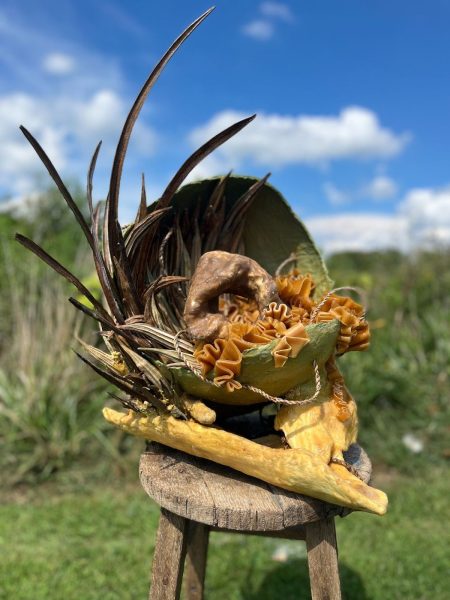
Ultimately, her work is a year-long process because of the growing seasons of her materials.
“It takes a lot of time, both in the sense of the time making it, but also the time of thinking about how I’m going to use it sometimes,” Wolfe said.
Wolfe recommends building relationships with people, such as gardeners.
“People who know and care about plants and our hyperlocal environments can be amazing resources because they want to help people. They want to help other creatives,” Wolfe said.
But the environment’s impact on her work doesn’t end with the materials that she uses. One recurring shape in her work, which she describes as a “gentle curve,” comes from nature.
“It’s all of those kind of gentle curves that we see in the environment and the land all around us. And I’m never not looking at that, where the more that I see, the more of it I absorb,” Wolfe said.
She also keeps the environment in mind when creating artwork, as many art processes create waste and toxic byproducts.
“The big reason why I make the work that I make, [is] not only cost but [also] environmental impact,” Wolfe said.
For example, she saves cardboard to use as the interior armature in her sculptures, and uses newspapers she receives for papier-mâché.
“I mean, so much of it for me, when I started making this work, was not only exploring the capabilities of the material to find out what they could do, what I could do with them, but also I was broke, like I couldn’t afford anything,” Wolfe said. “I started making these things because these objects were free or accessible, and it just kind of grew from there, and continuing to refine it over the years of where I want to go and where the materials and I can go together.”
“I mean, that’s foundational, is reducing my environmental impact goes hand in hand with keeping my costs down,” Wolfe said.
For those interested in keeping up with her work, her Instagram is @commonfinish, and her website is Sarah B. Wolfe.