
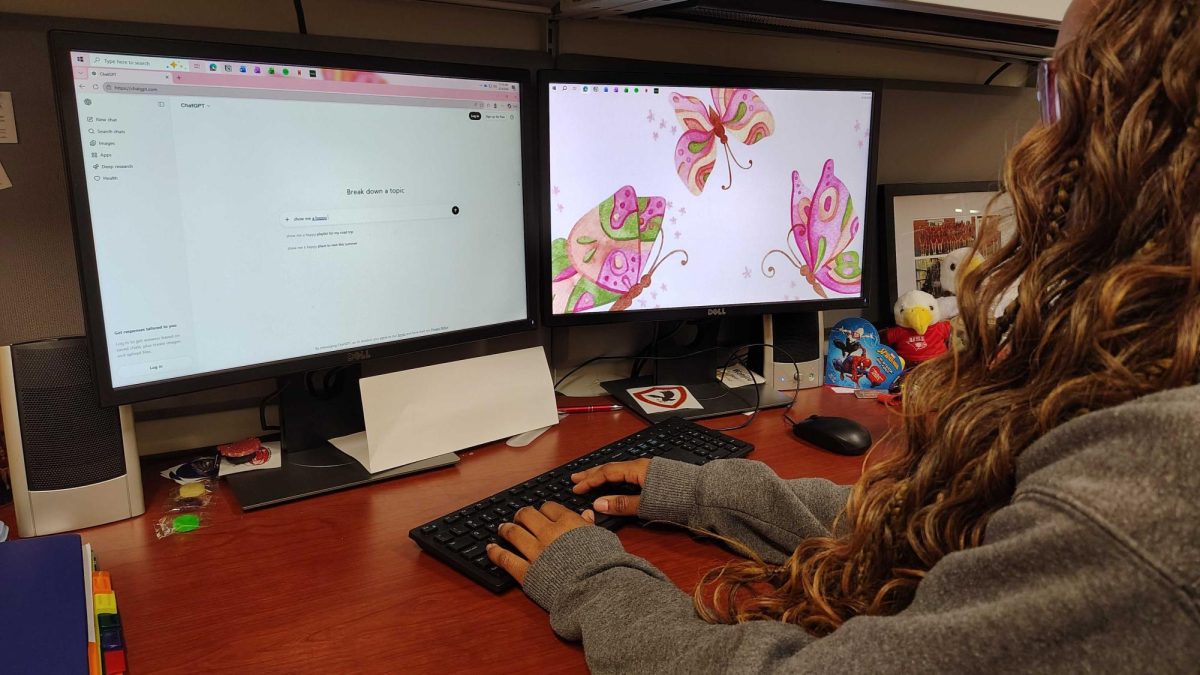
Over the past couple of years, it’s hard not to have heard about artificial intelligence. AI was first coined in 1956 with the Dartmouth Summer Research Project.
Generative AI has skyrocketed in popularity over the past 3 years.
I first remember AI coming onto the scene in the spring of 2023, and like most, thinking it was a cool new tool.
In the past two years, AI has only become more powerful and popular, especially in college settings.
What many people don’t talk about is the effects the AI has had on the environment and communities.
AI is being powered at data centers, which are temperature-controlled buildings that house servers, data storage drives, and network equipment.
Amazon has more than 100 data centers worldwide, each with around 50,000 servers.
Massachusetts Institute of Technology News reported last January that data centers have been around since the 1940s, and the rise of AI has led to more construction of centers.
MIT News also shares this quote from Noman Bashir, who leads the MIT Climate and Sustainability Consortium’s work on data & computing, “What is different about generative AI is the power density it requires. Fundamentally, it is just computing, but a generative AI training cluster might consume seven or eight times more energy than a typical computing workload.”
A big issue with these data centers is the water consumption.
According to the Environmental and Energy Study Institute (EESI), as of June 25, 2025, large data centers consume up to 5 million gallons of water per day, which is equivalent to the water use of a town with 10,000 to 50,000 people.
The rapid expansion of data centers threatens freshwater supplies. Only 3% of Earth’s water is freshwater, and only 0.5% of all water is accessible and safe for human consumption.
USI, like many schools, has an AI policy.
A lot of classes will fail you for using AI. Some classes have required students to use it. I took a class about AI use in geriatric care, where we used generative AI almost every day.
The class itself was very interesting and I came away knowing a lot more things, I would have liked to not have used AI as much and have done my own research.
Jamison Meyer, freshman political science major, gave his thoughts on AI.
“I think AI is helpful in a sense when it is used as a tool. I think there’s a big gray area of the accountability and when and why people are using it, and how accessible it’s become,” Meyer said. “I think that’s our biggest issue, though.”
Meyer said he has used AI for class.
“A lot of the time we have to use it for prompts and to see what output it will give us and how we can tweak it to give us what we’re wanting more specifically,” Meyer said.
Maddox Taylor, freshman criminal justice major, said he does not like AI.
“I think that it is overall negative and harmful to our environment. People should not use it because of its impact on our environment,” Taylor said, “Use of generative AI is also really horrible because most of the time it’s based on outdated information and sources, so half of what they’re saying isn’t even true anymore.”
He also said people can use AI for negative things, like image generation and editing.
Keaira Richmond, junior political science major, said she doesn’t think AI should be permissible in settings like education.
“I definitely think AI is something we’re going to have to use in our lives, and we should probably get better at learning how to use it as a tool and a resource rather than something to just cheat and something to make ourselves less educated,” Richmond said.
Richmond says that she thinks AI can be used as a good resource in terms of making a study guide or helping in business classes.
“But in terms of schools and specifically in the humanities and writing, since I’m in the humanities, I don’t think it’s morally a good thing,” Richmond states.
Richmond has many concerns about the use of AI, one being that it makes people lazy.
“I think a lot of people will just overuse it, and I do have a lot of concerns about environmental factors and how that looks and the research into that, because I don’t know if we have enough research to determine yet how bad it is for the environment,” Richmond said.
Like students, professors also have opinions on AI
Jennifer Skelton, assistant professor of health informatics, writes to The Shield, “Generative AI products like ChatGPT, Copilot, and Gemini are just tools. Like steam engines, calculators, telephones, or the internet, AI tools can be used for ‘good’ or for ‘bad’.”
Skelton said she supports the knowledgeable, responsible, and ethical use of gen AI in college courses because AI isn’t going away anytime soon.
“In fact, AI products are advancing so rapidly and becoming so integrated into our everyday lives that it is sometimes hard to know what responsible and ethical use is,” Skelton wrote.
Skelton said it’s why universities need to offer AI training for students to have a safe place to explore its uses.
Last fall, Skelton and some of her colleagues wanted to see what students thought about generative AI.
They conducted a survey, inviting over 3,000 students from the Kinney College of Nursing and Health Professions and the College of Liberal Arts to participate.
They gathered over 300 responses, mostly of undergrads, with a somewhat equal response rate between the two colleges.
According to the responses:
- Over 50% of respondents reported using generative AI tools ‘somewhat frequently’ for their academic work
- Almost 90% of respondents were ‘somewhat unlikely’ or ‘unlikely’ to use gen AI to write a paper or take an exam
- Respondents reported using generative AI to provide feedback or edit their writing, brainstorm for class projects, or summarize readings.
- They also reported using generative AI to generate citations, create flashcards, clarify topics, create practice quizzes, or synthesize PowerPoints from their class notes
- Respondents reported using generative AI to create study plans for time management and to help handle academic stress
- 37% of students reported that they would not use generative AI tools because they feel that would be considered plagiarism and undermine their learning
Skelton wrote that a common concern raised in the study was the environmental impact of AI use, something they had not expected.
“The findings suggest that while gen AI tools are known and increasingly incorporated into USI students’ academic workflows, their use remains intentional and guided by ethical boundaries,” Skeleton wrote. “However, only 55% of students report feeling prepared to use gen AI tools in their future career, highlighting a gap between current classroom practice and evolving workforce expectations.”