

The Holocaust is truly one of the most infamous and horrendous events in human history. It is so bad that most parents and educational supervisors censor the topic. The unethical procedures carried out by the Germans in the Second World War are considered far too unethical for young adolescents to study in depth.
However, the Jewish Holocaust is still an extremely crucial aspect of history to learn about. One cannot just act as if the Holocaust never occurred; that would be disrespectful. After all, what’s the point of learning about our history if we just blur out all the bad parts?
Fortunately, the University of Southern Indiana shares this perspective. Todd Schroer, director of the Rechnic Holocaust Speaker and Film Series, explained that the Holocaust needs to be brought up in every educational facility, as it’s far too significant to overlook.
For this reason, the USI Foundation has the Rechnic Holocaust Series. This event is to honor the late Irene C. Rechnic’s parents, who struggled to survive the Auschwitz-Birkenau concentration camp during World War II, where 960,000 Jewish people were executed. The film series was a two-day event with two films each day. The films were then followed by either a speech or a Q&A to fulfil the audience’s needs.
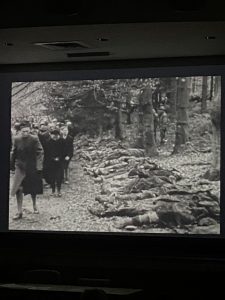
The Rechnic Holocaust Film Series began Feb. 25 and was composed of two films: Billy Wilder’s 1945 documentary “Death Mills,” and Orson Welles’ 1946 film “The Stranger.”
These films provided two very different descriptions of the Holocaust.
While “Death Mills” prioritized showing the real aftermath of the concentration camps, “The Stranger” prioritized telling the fictional story of the Second World War’s aftermath.
In other words, “The Stranger” is fictional, whereas “Death Mills” is not.
Although “The Stranger” was more entertaining to watch, it failed in doing what “Death Mills” succeeded in: portraying the sad and gruesome reality of the Holocaust.
As stated by Alexandra Natoli, assistant professor of French, “The Stranger is a very stylized portrayal of the American dream. It’s lacking in humanizing the Holocaust.”
On Feb. 26, the second day of the Rechnic Holocaust Film Series, there were two short films: Alexandra Garcia’s 2016 short film “The Forger” and Eileen Angelini’s 2011 documentary “France Divided.” Both are nonfiction works and discuss the situation in France during WWII.
After the screening, Angelini hosted a speech and Q&A.