
Matt Hanka, professor of political science, discusses the United Nations’ evolution and questions its relevance nearly 80 years after its founding during a recent presentation.
Formed in 1945 after World War II, the UN was established to prevent future conflicts and promote peace. It replaced the League of Nations, which had failed to stop aggression from Axis powers leading up to the war.
Hanka outlined the UN’s structure, focusing on its six principal organs: the Security Council, General Assembly, International Court of Justice, Trusteeship Council, Economic and Social Council (ECOSOC) and the Secretariat. Each plays a distinct role in maintaining peace, creating policy and addressing economic and social issues.
The Security Council includes 15 members—five permanent and 10 rotating—tasked with maintaining international peace and security. The General Assembly allows all member states to debate global concerns, while the International Court of Justice handles disputes between nations. Specialized agencies such as the World Health Organization (WHO) and the Food and Agriculture Organization (FAO) focus on health, agriculture and humanitarian issues.
The UN has also influenced international policy through conferences such as the 1992 Earth Summit, the 1995 Beijing Conference on Women and the 2015 Paris Agreement on climate change. It set measurable global targets for poverty reduction and human rights through the Millennium Development Goals (MDGs) and Sustainable Development Goals (SDGs).
“Now, this is 80 years of work and we’re going to talk about whether or not this is too much, or whether the UN is collapsing under its own weight… because there’s so many problems in the world,” Hanka said.
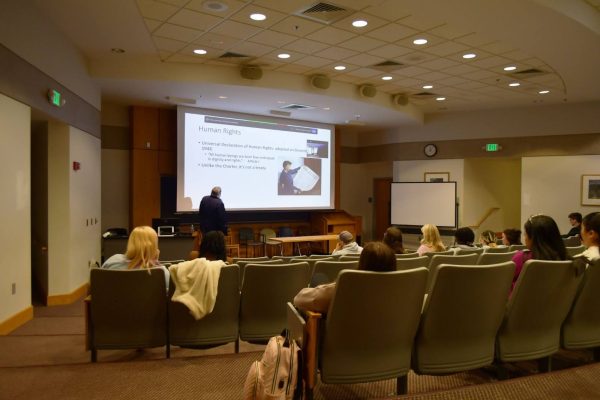
While critics argue the organization has become ineffective or overly bureaucratic, Hanka continues to ask, “Is the UN relevant?” He believes it is. According to Hanka, the UN remains a crucial platform for diplomacy and cooperation.
“It’s the only form of its kind that people can debate and discuss and they can work with other countries to engage in cooperative and collective action on a number of issues,” he said.
Hanka pointed to the UN’s humanitarian and peacekeeping efforts as proof of its ongoing impact.
“Is the UN relevant? Yes, because it provides immediate relief, humanitarian laws,” he said. “It’s relevant because it’s allowed over a billion people to get out of extreme poverty in the world.”
He added that because of the UN, more humanitarian issues, like women’s and children’s rights, are at the forefront.
One of the UN’s biggest challenges, he said, is funding. Smaller nations often hesitate to rely on the organization for solutions due to limited financial resources, while larger powers are more likely to act independently.
“It’s relevant if it’s funded properly, and right now there’s challenges towards funding from all countries, including the United States,” Hanka said.
He also noted the organization’s struggle with legitimacy, referencing tensions between unilateralism and multilateralism.
“Is it relevant if the major powers like the United States or some of the Security Council don’t respect its legitimacy and decide to go it alone?” he asked. “This notion between unilateralism—go it alone—versus multilateralism, which involves multiple states engaging in cooperative action, is not just an issue for the United States. Others are willing to go it alone too.”
Hanka said it is naive to think that other nations would follow if the United States were to withdraw from the UN. Instead, he warned, countries such as Russia or China could take on the leadership role the U.S. currently holds within the Security Council.
He also linked recent American political rhetoric to a broader trend of isolationism. The “Make America Great Again” slogan, he said, reflects a retreat from international leadership and engagement in world affairs.
The UN’s effectiveness, Hanka argued, depends heavily on leadership and reform. He believes there is potential to redesign the organization to better address today’s challenges.
“Maybe the structure of the Security Council and the institutions themselves need to be rethought,” he said. “When you’re at your birthday party, you’re also talking about your funeral—it sometimes feels that way when talking about the UN.”
Still, Hanka said the organization continues to evolve.
“Do you need to redesign it to refit the geopolitical climate? Yes,” he said. “If we continue to defund it, continue to delegitimize it and don’t see its relevance, we risk losing one of the only institutions capable of global cooperation.”