
“Thinking Hands” is the latest show in the Kenneth P. McCutchan Art Center/Palmina F. and Stephen S. Pace Galleries.
Comprised of artwork created by fourteen of USI’s Art and Design department faculty members, the show contains artwork from almost every medium. It will remain on display until Oct. 19.
While there are many incredible works in this show, here are a few of my personal favorites.
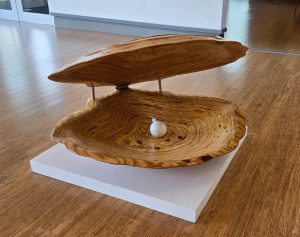
“GMO” by Greg Blair, assistant professor of art and design, immediately caught my eye upon entering the room. I love how he layered the pine wood and carved into it to create the sculpture’s growth rings and organic shape.
This piece sent me down a rabbit hole about oysters, abalones, mussels, scallops, clams and conches to figure out which it was. While I won’t make you sit through oyster unboxing videos or sift through recipes that explain the flavor differences between clams and mussels, I will explain why I think it is a clam.
The hinge of an oyster is on the long end, abalones and conches have a different shape than the sculpture and the ridges of a scallop flare outward from the hinge. Clams and mussels can look similar, but mussels have slightly different shapes and coloring. They can also make pearls, but it’s not as common. So, it’s probably a clam.
GMO stands for genetically modified organism. Although a lot of people are afraid of this word, it isn’t inherently a bad one. According to the FDA, the majority of the corn grown in the United States is genetically modified and it is modified to make it more resistant to pests, among other reasons. Varieties of genetically modified potatoes can help reduce food waste and make it less susceptible to disease. But what does that mean for this sculpture?
According to the Woods Hole Oceanographic Institution, Clams are filter feeders and they can incorporate what they filter into their tissue and shells. From what I understand, climate change can cause harmful algal blooms. These can then produce phycotoxins, which can accumulate in bivalves, like clams, making people who consume them sick.
“Bivalves are the main carriers of phycotoxins produced by toxic microalgae in the marine food web and they are an important source of animal protein for humans.”
Long story short, this is about bioaccumulation and biomagnification. Bioaccumulation is when an organism accumulates more toxins over time, while biomagnification happens when one organism eats another. Let’s say you’re a seal. If you eat one little fish, you’re probably going to be hungry. So you eat multiple. If those fish have toxins in them, congratulations, you now have their toxins. The higher up the food chain you are, the more toxins you can collect.
If this artwork is about climate change, bioaccumulation and biomagnification, I don’t know that the clam would be considered a genetically modified organism, because the potential buildup of toxins within it is not being intentionally and directly done by humans. But the pearl, looking like a bomb, does seem to be commenting on the dangers of eating clams.
Regardless, the piece is stunning and was placed front and center for a reason.
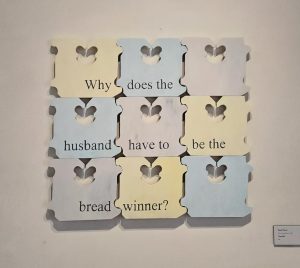
Another eye-catching piece by Blair is “Bread Winner.” Despite its pastel color palette, it caught my eye from across the room and drew me to it.
To me, this piece represents the invisible (ignored) labor that is required to keep a home running. I can imagine a stay-at-home parent asking themselves this question each time they open a bread bag to pack their kid’s lunch. I appreciate the subtlety and the question being split across multiple bread tags, because it’s not about having to pack lunch once, it’s about the years of chores that need to be done weekly or even daily.
Where I wish this piece went is outside of money. It asks, “Why does the husband have to be the breadwinner?” The answer is because a woman’s labor is not valued.
According to the Pew Research Center, Women have been found to be paid only 85% of what men are paid. If only one parent is working, it generally makes more financial sense for the woman to stay home, because then the family is missing out on less potential income. With the cost of childcare being so high in the U.S., for some families, it makes sense for one partner to stay home, instead of paying that cost. But for many families, it is necessary for both parents to work.
While the financial burden for supporting the family has now shifted, the domestic one hasn’t. Many women are responsible for keeping the home clean, feeding everyone and taking care of the children, in addition to working full-time.
The better question isn’t ‘Why do men need to work?’ It’s ‘Why are women still expected to do everything?’
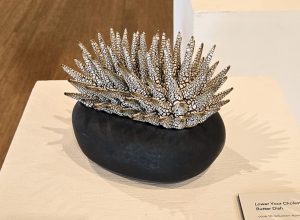
I love art that is playful and humorous, especially when the title of the piece changes your interpretation of it, like this butter dish by Al Holen, professor of ceramics.
Before reading the title, I thought it was an abstract sea urchin, but afterward, I really appreciated how the form affected the function of this; it’s supposed to be a butter dish that is inconvenient to use.
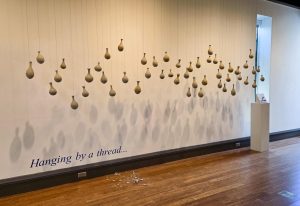
I really enjoy how Holen took advantage of one of the innate properties of clay, how fragile it is before firing, to create this piece.
Intentionality is something that can really elevate an artwork. “Hanging by a Thread” responds to the question of ‘Why this medium for this idea?’ with ‘Because it is the best way to tell it,’ when many artworks would say, ‘Because this is the medium I like to work in.’
The addition of the scissors also changes my interpretation of the piece. Had the scissors been excluded, it would have been about weakness. ‘You were too weak to keep it together.’ But the scissors add malice to it, which is interesting. Are you sabotaging yourself? Or is someone else standing in your way?
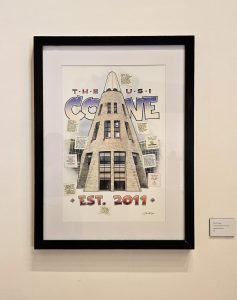
The drawing of the cone is great, and so is the overall composition of the piece. The fonts, color palette and overall style make me nostalgic for when my family still got newspapers and I would immediately flip to where the cartoons were. The text bubbles definitely add to the comic book feel.
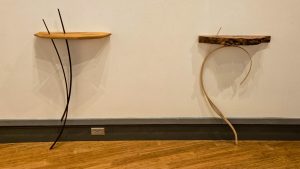
Of the two console tables, the one on the left is definitely my favorite. Although they are both playful and delicate, while still being functional, I prefer modern aesthetics to rustic ones.
They just have such a strong sense of line and rhythm that I rarely see in woodworking, especially not on such a small scale.
I almost want to hold my breath when I walk by them to keep them from tipping over.

Over the summer, I went to the Denver Art Museum and took a photo of almost every single chair that they had in their Kirkland building, which contains design from the Arts and Crafts movement until Postmodernism, so it’s safe to say that I have an abnormal relationship with interior design, but I wholeheartedly believe that the “Kagami Chairs” are ones that even normal people can appreciate.
These chairs are so playful and have such a strong sense of line and silhouette. They feel off balance, yet they aren’t. It really is a marriage between whimsy and functionality. Their arced lines point you to the seat, inviting you to sit down. They just feel so lively, like they could be in a more modern version of “The Beauty and the Beast.”